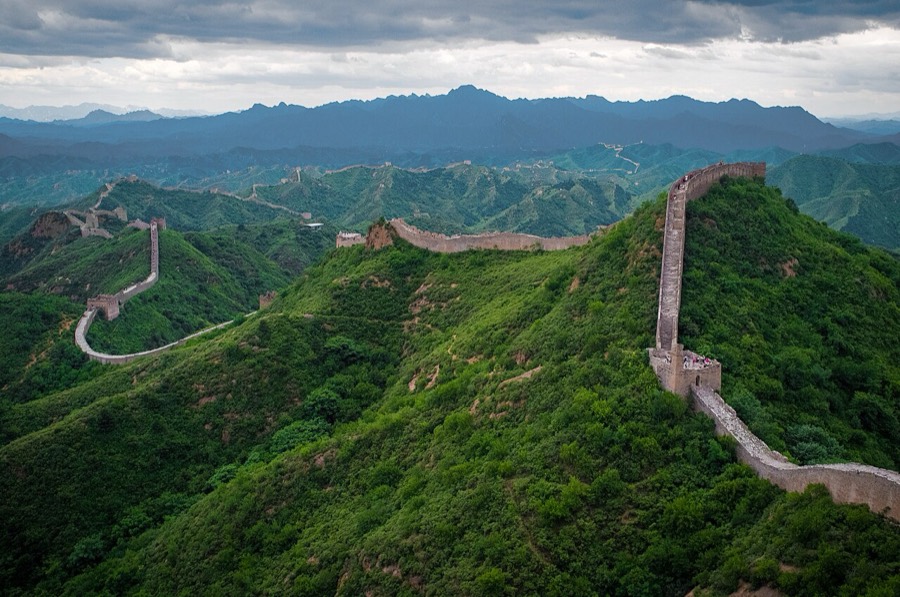
The Great Wall changes dramatically across China. Choose the landscape and history that interest you: Han-era desert remains, a Ming frontier fortress, mountain ramparts near the capital, or the meeting of wall and sea. These are separate regional trips, not four nearby sections of one day’s visit.
City photos: Dunhuang — 白云悠悠, CC BY-SA 3.0; Jiayuguan — Doron, CC BY-SA 3.0; Beijing — Gary Todd, CC0; Qinhuangdao — Charlie fong, CC BY-SA 4.0.
With your destination chosen, decide which sites or wall sections to include and how to connect them. The guidance below changes with your selection, so you can focus on the transport, walking and itinerary choices that apply.
Beijing: restored mountain sections
Beijing is the easiest base for a first Great Wall visit, but the Wall is outside the urban center. Choose the section first, then match the day’s transfer and walking pace to it.
Badaling · the landmark visit
About 60 km northwest of central Beijing, Badaling is a prominent, restored Ming section and a popular introduction to the Wall’s scale and defensive architecture. It suits a day trip focused on the best-known visitor site.
Mutianyu is a Ming section known for dense watchtowers and wooded mountain scenery. A self-guided public-transport route is possible, with a bus from Dongzhimen toward Huairou followed by a local bus to the site; a transfer or tour makes the day simpler.
Here the Wall feels like a fortified edge of the desert. The city’s official heritage area brings together three contrasting parts of the defense system, making this a compact, purposeful stop on a western China itinerary.
Walk the pass and its defenses
Start at Jiayuguan’s fortress, the fortified gateway and command center. Add the First Pier, a beacon tower above the Taolai River gorge, then the Overhanging Great Wall, which climbs the Black Mountain slope. A driver or organized local transfer connects these separate sites.
Compared with Beijing’s wooded ridges, Jiayuguan’s setting is open and arid, with the fortress framed by desert and distant mountains. Give the area time for all three sites, or use the city as one leg of a longer journey through the Hexi Corridor.
Dunhuang is the westernmost destination in this guide, with Han-era walls, passes, and beacon towers beyond the Ming endpoint at Jiayuguan. It is not the westernmost extent of the entire Great Wall defense system: Han and Tang frontier sites also survive farther west in Xinjiang. Come for the earthen remains, the Gobi, and the Silk Road landscape.
Plan a vehicle excursion from Dunhuang to Yumenguan and nearby Han remains. The remote desert setting means advance transport planning matters; this is best treated as a dedicated outing, with enough time to explore the archaeological landscape without rushing.
Build a slower Dunhuang stay around the passes, the Gobi, and the Mogao Caves. The wall’s earthen construction and scattered watchtowers make the ancient frontier feel inseparable from the routes and oasis settlements it protected.
Shanhaiguan offers an eastern counterpoint to Jiayuguan: a major Ming pass between mountains and coast, plus the famous seaward terminus at Laolongtou, or Old Dragon’s Head.
Pass, old town, and coastline
Visit Shanhaiguan for the fortified gateway and historic town, then continue to Laolongtou to see the wall meet the Bohai Sea. The day combines military architecture with a coastal setting instead of a long ridge walk.
Shanhaiguan is ideal if you want to understand how a pass, a walled town, and coastal defenses worked together. Stay in the Qinhuangdao area to give the historic sites and the sea room in the itinerary.
A personal perspective on the visit, and the choices I’d make next time.
My experience
My first wonder, and the one I remember least. I was six years old; my dad had a work trip to Beijing and I tagged along, and we did a day trip out to the Badaling section of the wall. Beyond that the memory is thin — I was six.
If I went again
I would still love to see the western ends of the wall eventually. The sections out towards Jiayuguan and Dunhuang are a very different place from the Pacific coast of China — desert and oasis rather than the hills around Beijing — and that contrast is the reason to go back.
Next Planning details
04The field guide
More planning details
Choose the right railway station, connect the last leg to the Wall, and decide how the visit fits into a wider China itinerary. The four destinations below run from west to east.
01 · Start here
Get the rail booking right
Book the intercity journey and the transfer to the Wall as two separate parts of the plan. A fast train can save time, but the station you choose determines the journey after you get off.
Booking
Use 12306 and your passport
15-day window, including today
Search the China Railway website or Railway 12306 app for your travel date. The English website supports foreign passports; complete identity verification and enter passenger details exactly as required. Carry the original passport used for the booking when travelling.
Look at the full departure and arrival station names, journey duration and return options. North, South and West are different stations, sometimes well apart. Allow time for the city-to-station journey, security and passport checks; leave a buffer after sightseeing before your return train.
Road excursion to Yumenguan / Yangguan. Compare Liuyuan South only after adding its separate transfer.
Jiayuguan
Jiayuguan South · 嘉峪关南
Taxi or local buses to the visitor centre; arrange transport between the three heritage sites.
Beijing / Badaling
Badaling Great Wall · 八达岭长城
Leave the station and follow the scenic-area approach. Mutianyu needs a different road journey.
Qinhuangdao
Qinhuangdao · 秦皇岛
Continue by road to Shanhaiguan; visit Laolongtou as a separate coastal stop.
02 · Westernmost stop
Dunhuang: rail to the oasis, road to the ruins
The Han-era remains are well outside the city. Make Dunhuang your base, then give the western desert excursion its own time rather than treating it as a stop beside the railway station.
Rail arrival
Search for Dunhuang station first
Lanzhou West / Lanzhouxi 兰州西
Dunhuang 敦煌
Search Lanzhou West → Dunhuang for available through services, including bullet-train options. Dunhuang is connected to the wider Lanzhou–Xinjiang rail network, although the approach is not entirely on high-speed track. Compare the actual journey time shown rather than assuming every part is fast.
If considering Liuyuan South (Liuyuannan / 柳园南), add the separate road journey to Dunhuang before choosing. It is a different arrival point, farther from the city, and is not interchangeable with Dunhuang station.
Choose a driver, organized desert excursion or the scenic area’s advertised customized bus service. Its published routes include Dunhuang bus station → Yangguan / Yumenguan tourist area → town, with a railway-station connection also described. Confirm the operating day, boarding place and return before relying on it.
Specify that you want the Han wall remains as well as the pass sites. Check which stops and internal sightseeing transport are included; a broad ‘west-line tour’ can cover a large area.
The pass fortress, First Beacon Tower and Overhanging Great Wall are separate parts of the same heritage area. Getting to the city is straightforward; give equal thought to moving between the sites.
Rail arrival
Use Jiayuguan South for the high-speed corridor
Lanzhou West / 兰州西
Jiayuguan South / 嘉峪关南
Search this station pair in 12306, then compare services and any connections. Jiayuguan South is a documented stop on the Lanzhou–Xinjiang high-speed corridor. Zhangye West (张掖西) is another station to consider when breaking up a wider Gansu journey.
Keep Jiayuguan South distinct from Jiayuguan (嘉峪关), the city’s other railway station. Choose your pickup and onward transport using the station printed on the ticket.
A taxi is the simpler connection with luggage. The published local arrival guide also gives bus 10 from Jiayuguan South to Guanghui West Gate (广汇西门), then bus 9 to Jiayuguan Visitor Service Centre (嘉峪关游客服务中心). Confirm the current routing locally.
From Jiayuguan station, the same guide lists bus 1 or 15 to Renmin Shopping Centre (人民商城), then bus 9. Once at the heritage area, check the current inter-site shuttle or arrange a driver for the fortress, beacon tower and Overhanging Wall.
Badaling and Mutianyu are different outings. Pick the Wall section first, then book the matching journey; the convenient Badaling rail connection does not take you to Mutianyu.
Train-based visit
Badaling by high-speed rail
Qinghe 清河 / Beijingbei 北京北
Badaling Great Wall 八达岭长城
Search Qinghe → Badaling Great Wall, or Beijingbei → Badaling Great Wall, in 12306. Beijing’s current rail guidance documents both departure points. Qinghe connects with metro Line 13 and the Changping Line; Beijing North is at the Xizhimen interchange.
Allow time to leave the station and follow the signed approach to the scenic area. Keep the return journey and the Wall entry arrangements separate: a train ticket does not admit you to the monument.
The official public-transport route is express bus 916 from Dongzhimen to Huairoubeidajie, then H23, H3 or H71 to Mutianyujingqu. It involves a transfer, so compare it with a direct organized transfer or private driver if time is limited.
At the site, decide how much climbing to do and whether to use the cable car or other visitor transport. Check what your entry or transport package includes and where you need to return to meet your ride.
Qinhuangdao is the high-speed rail gateway for this coastal visit. Shanhaiguan is the district and historic pass to aim for after arrival; Laolongtou is the separate stop where the Wall reaches the sea.
Rail arrival
Search Beijing → Qinhuangdao
Beijing: check the departure terminal
Qinhuangdao 秦皇岛
Shanhaiguan 山海关
Compare the high-speed services to Qinhuangdao in 12306 and check the exact Beijing departure station before booking. From Qinhuangdao station, the tourism guide describes onward road transport to Shanhaiguan, with a taxi transfer of roughly 30 minutes as a planning estimate.
Shanhaiguan (山海关) is also a railway station and can be convenient when a suitable train stops there. Compare its actual services; do not assume that a high-speed search to Qinhuangdao and a search to Shanhaiguan produce the same trains.
Visit the fortified gateway and historic town, then take local road transport to Laolongtou for the seaward Wall. These are distinct stops: plan the connection and confirm which admission products cover the places you want to enter.
For a day trip, choose a return train that leaves room for both visits and the drive back to the station. Stay in the Shanhaiguan / Qinhuangdao area if you want a slower old-town and coast visit.
These are suggested ways to group the visits, not fixed tour schedules. Confirm each rail leg for your dates before committing to hotels or a same-day connection.
Northern China
Beijing + the coast
Use one day from Beijing for Badaling or Mutianyu, then travel separately to Qinhuangdao / Shanhaiguan. An overnight at the coast gives the pass and Laolongtou room in the itinerary. Avoid trying to combine a Beijing mountain section and the coastal Wall into the same sightseeing day.
Build a trip around Lanzhou, optionally Zhangye, Jiayuguan and Dunhuang, travelling in either direction. Give Jiayuguan time for its three sites and Dunhuang a separate desert-excursion day. Check the exact western rail leg rather than assuming every city pair has a convenient direct departure.
Transport guidance reviewed 16 October 2026. Sources are linked beside the relevant advice. Suggested pacing is editorial; departure times, fares and availability come from the live booking systems.